
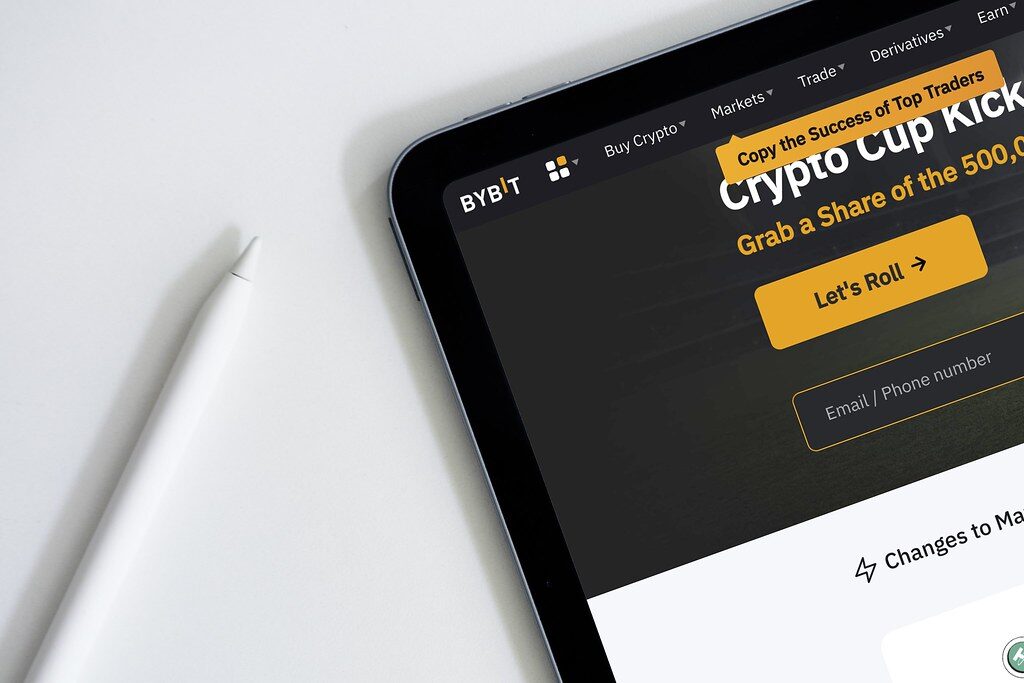

Search for Bybit.eu reviews and you will find two kinds of text. Affiliate pages that call it the best exchange in Europe, and angry app store comments from people whose withdrawal got stuck. Neither helps much if you are trying to decide whether to open an account. So here is what Bybit.eu actually is, what users like about it, what they complain about, and who should probably skip it.
Bybit.eu is not the same company as Bybit.com
This trips up a lot of readers. Bybit started in 2018 and grew into one of the largest crypto exchanges in the world, run from Dubai and best known for high-leverage derivatives. Bybit.eu is a separate entity, Bybit EU GmbH, based in Vienna. On 28 May 2025 the Austrian Financial Market Authority (FMA) granted it a licence under MiCA, the EU’s crypto regulation. That licence is passported across the European Economic Area, so it covers users in Poland, Germany, Spain and the rest of the EEA.
EEA customers were migrated from the global platform to Bybit.eu. If you read a review that talks about 100x leverage or hundreds of obscure tokens, it is describing the global product, which you cannot legally use from the EU.
What users like
The praise is fairly consistent across reviews and forums. Spot trading fees start at 0.10% for both makers and takers, which is low for a regulated platform. The mobile app is fast and stays responsive when the market is moving hard, which is exactly when cheaper apps tend to freeze. People also like having copy trading, Earn products and the Bybit Card in one place.
Then there is the licence itself. Under MiCA, client assets have to be kept separate from the company’s own money, and the FMA can inspect, fine or revoke. For many users that matters more than any feature list.
What users complain about
KYC comes up most often. Verification usually takes minutes, but plenty of people report documents rejected without a clear reason, repeated requests for proof of address, or questions about the source of funds after a larger deposit. Some of this is just EU anti-money laundering rules. Some of it is Bybit being heavy-handed and not explaining itself well.
Support is the second complaint. Live chat answers quickly, but anything unusual (a missing deposit from before the migration, a frozen withdrawal) tends to bounce between template replies. Users moved over from Bybit.com also grumble about the smaller token list and the loss of high-leverage derivatives.
The hack nobody can ignore
In February 2025, attackers drained roughly $1.5 billion in ETH from a cold wallet belonging to the global Bybit platform. The FBI attributed it to North Korea’s Lazarus Group. Bybit covered the loss, kept withdrawals open and restored 1:1 backing within days. Customers did not lose funds. You can read that as proof the company survives a disaster, or as a reminder that no exchange is safe enough to hold your savings. Both readings are fair, and they lead to the same habit: keep long-term holdings in a wallet you control.
Fees in practice
The 0.10% spot fee is the cheap route. Buying with a card or through the one-click “buy crypto” button costs noticeably more, because you pay a higher fee plus a spread baked into the quoted price. Most “Bybit overcharged me” reviews come from people who used the convenient option without reading the quote. Crypto withdrawals carry a network fee that depends on the chain you pick.
What signing up involves
Registration takes a few minutes: email or phone number, a password, a confirmation code. Before you can deposit money or trade, you go through identity verification with an ID card or passport and a short selfie video. Bybit may also ask for proof of address. Once you are in, switch on two-factor authentication through an authenticator app rather than SMS, set an anti-phishing code for emails and turn on the withdrawal address whitelist. These take five minutes and prevent most of the account takeovers that end up as one-star reviews.
So, is it worth registering?
Yes, if you mainly buy and hold crypto, want low spot fees and prefer a regulated EU company on the other side of the contract. It also suits people who want to try copy trading in a controlled setting.
No, if you trade derivatives with high leverage or chase newly listed tokens. Bybit.eu will frustrate you, and using a VPN to reach the global site breaks the terms of service and can get your account frozen.
If you want to see how this plays out for real users over several years, there is a long-running forum thread on whether Bybit is worth using on Beatcoin, a Polish crypto community. It is in Polish, but a browser translation gets you the gist, and the posts cover withdrawals, verification and the migration in more detail than any review page.
Whatever you decide, start small. Deposit a modest amount, buy on the spot market, then withdraw some of it to your own wallet. If all three steps go smoothly, you have your answer, and it cost you very little to get it.